
Norway Is Rethinking Childhood. Why Aren’t We?

Recently, a statement stopped me in my tracks:
“Norway has decided to revert to traditional education.”

The post went on to say that generative AI had been banned from primary schools, screens were being replaced with printed textbooks and smartphones had been removed from Norwegian schools.
It is the kind of message that travels quickly online because it appears to confirm something many parents and educators are already feeling:
Childhood has become too digital, too hurried and too focused on the next measurable outcome.
Ready to create more calm, connection and unhurried play in your setting?
Join my free 30-minute training, 3 Steps to Calm, and discover three practical changes you can begin making straight away. Watch here!
As an early years consultant who has spent more than 20 years working with young children—and now as a mum watching my own four-year-old begin Reception—I feel this deeply.

But the phrase “traditional education” also needs careful unpacking.
Because if we are not careful, “back to basics” can be interpreted as more adult-led teaching, more sitting still, earlier formal instruction and less time to play.
That is not the lesson I believe we should take from Norway.
Norway is questioning the uncritical use of screens, smartphones and artificial intelligence in education. It is renewing its investment in printed books, handwriting, reading and foundational knowledge.
But Norway’s early childhood framework still places enormous value on play, relationships, movement, sensory experience, exploration and time spent in nature.
So perhaps the real question is not:
Should we return to traditional education?
Perhaps it is:
Have we forgotten what the true foundations of childhood are?

What is actually changing in Norway?
The viral post contains some truth, but it brings several different policies and research findings together in a way that makes the story sound simpler—and more conclusive—than it really is.
In 2024, Norway introduced national recommendations encouraging schools to restrict mobile phones and smartwatches. The country has since continued to reassess the place of digital technology in children’s lives.
From the beginning of the 2026–27 school year, Norway introduced a near-total restriction on generative AI for pupils in Years 1–7. Older children may use it cautiously under teacher supervision, while upper-secondary pupils will be taught to use it appropriately.
The Norwegian government has also committed to bringing more printed books back into classrooms after years of increasing reliance on tablets and digital resources. Reuters reported on Norway’s new restrictions and investment in printed books here.
This is not simply nostalgia for how schools used to be.
It is a recognition that young children need to develop their own capacity to read, write, think, remember, imagine and make meaning before technology begins doing too much of that work for them.
There is evidence from Norway suggesting that smartphone restrictions can benefit attainment, bullying and girls’ mental-health outcomes. However, we should be cautious about repeating claims that these national changes have already caused a particular percentage improvement. Much of the research examined local school policies introduced before Norway issued its nationwide recommendations—not results produced afterwards by a single national ban.
The wider message remains important: Norway is willing to pause and ask a question that should sit at the heart of every educational decision:
Is this actually serving children?

That is a question we should be asking far more often in the early years.
Is the tablet serving the child—or simply making the day easier for adults to manage?
Is the phonics activity meeting the developmental needs of this three-year-old—or responding to adult anxiety about school readiness?
Is the carefully styled invitation deepening children’s play—or interrupting it?

Is the weekly topic helping us listen to children—or preventing us from following where their curiosity might lead?
Norway is also turning back towards real books
One part of Norway’s direction that particularly resonates with me is its renewed emphasis on physical books and reading aloud.
In June 2026, Norway’s education minister, Kari Nessa Nordtun, called for screen use to be reduced or removed from kindergartens and asked for the national kindergarten framework to be updated.
She wanted books and reading aloud to have a much clearer place in children’s daily lives. The Norwegian government also allocated funding for more books in kindergartens.
This matters.
A real book asks something different of a child.
It can be held, carried and explored. Its pages have weight and texture. A child can return to a favourite picture, notice a tiny detail in an illustration or ask for the same story again and again.
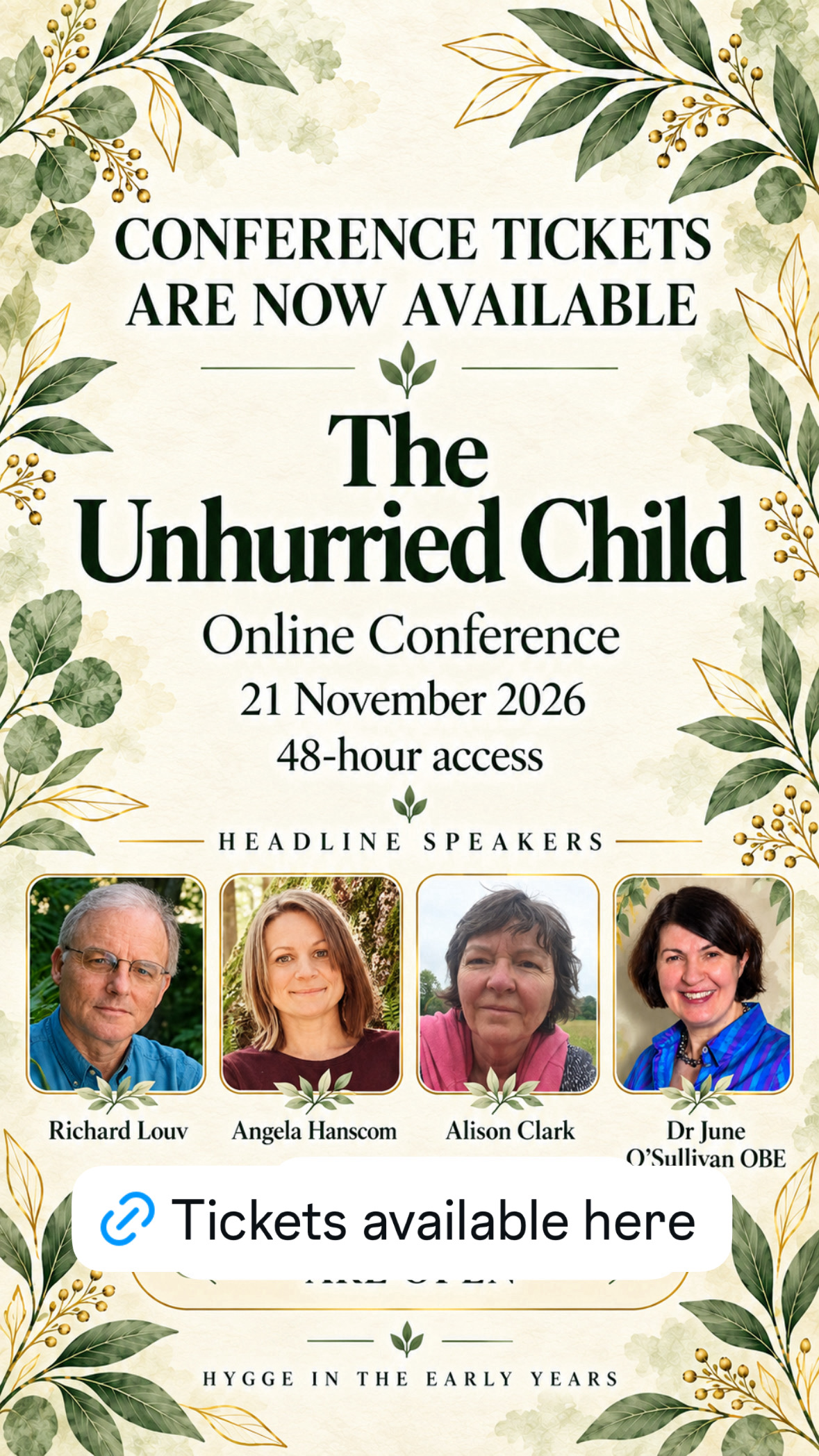 Join Me For The Unhurried Child ONLINE Conference
And if this way of thinking resonates with you, then I’d love to invite you to join me for The Unhurried Child Online Conference.
This online conference is for Early Years educators who know that childhood should not be rushed. It is for those of us who want to move beyond worksheet-led learning, tick-box pressure and constant adult-directed tasks, and come back to what young children truly need.
Across the conference, we’ll be exploring slow pedagogy, whole-child development, play, connection, movement, outdoor learning and how to create practice that feels calmer, more intentional and deeply respectful of young children.
If you are ready to protect play, nurture wellbeing and place the whole child at the heart of your practice, I would love you to join us.
Come and be part of The Unhurried Child Online Conference and explore how we can create Early Years practice that gives childhood the time, space and meaning it deserves.
A book does not flash, ping or hurry them onwards.
There is no algorithm deciding what they should see next.
There is simply the child, the story and the adult sharing it with them.

Since O started Reception, I have been reminded again of just how much young children are processing. There are new people, longer days, new routines and unfamiliar expectations. Even when a child appears to be coping beautifully, their body and nervous system are working incredibly hard.
At the end of those days, I do not believe he needs more digital stimulation or a stream of educational activities.
He needs familiarity.
He needs closeness.
He needs to curl up with us and hear a real story.
He loves books, from stories that make him laugh to the Roald Dahl chapters that carry us into another world. The page becomes a shared point of attention. We pause, wonder, predict and return to favourite moments. Sometimes the conversation wanders far away from the original story—and that wandering is part of the richness.

Reading aloud is not simply a strategy for raising attainment.
It is relational.
It tells a child:
There is nowhere else I need to be. I have time to share this with you.
“Back to basics” should mean back to childhood
When I think about the foundations children need, I do not think about flashcards, challenge sheets or timetables packed with adult-led activities.
I think about:
- Secure relationships with adults who know them well.
- Long, uninterrupted stretches of play.
- Daily time outdoors in every season.
- Real books and stories read slowly and often.
- Movement, climbing, carrying, digging and building.
- Real conversations without an adult rushing towards a learning objective.
- Open-ended materials that can become whatever the child needs them to be.
- Familiar rhythms that help the nervous system feel safe.
- Time to return to an idea tomorrow—and the day after that.
These are not optional extras to be fitted in once the “learning” is complete.
They are the learning.
Norway’s national framework for kindergartens reflects this beautifully. It recognises the inherent value of play and says children should be able to use their whole bodies and all their senses as they learn.

It also expects kindergartens to give children outdoor experiences, introduce them to the diversity of the natural world and help them feel connected to nature. You can read Norway’s Framework Plan for Kindergartens here.
This is a much richer understanding of “the basics” than simply putting pencil to paper sooner.
Nature is one of childhood’s first books
Before children learn to read words, they are already learning to read the world.
They notice that the air feels different before rain.
They recognise the call of a familiar bird.
They find the first blackberry beginning to ripen.
They watch water disappear into dry soil and wonder where it has gone.
They discover that a log is heavier when it is wet and that a hill feels steeper when their legs are tired.
This is real knowledge, gathered through the body and the senses.
O has always been fascinated by the natural world—birds, moths, volcanoes, maps and sea creatures. Recently, he climbed his first mountain. There was no worksheet at the top and no certificate needed to make the experience valuable.
He was learning through every step.
He was judging distance, balancing his body, managing tiredness, noticing changes in the landscape and discovering what he was capable of.
Those experiences then follow us into our books and conversations. We look at maps, find stories, identify creatures and return to questions that began outside.
This is why I do not see books and nature as competing with one another.
They deepen each other.
A story about a woodland creature can make a child look more closely beneath a tree. Discovering a feather outdoors can lead us back to a field guide. Watching the seasons change can give meaning to language that might otherwise remain abstract.
 Nature gives children something real to wonder about. Books give that wondering somewhere further to travel.
The danger of schoolification
Across the UK, early years educators are working under intense pressure.
They are expected to prove progress, prepare children for the next stage, collect evidence and make learning visible to adults. Even when nobody explicitly asks for more formal teaching, the pressure can quietly creep into practice.
Play becomes a reward after the adult-led task.
Provision is filled with laminated prompts.
Three- and four-year-olds are expected to rotate around activities.
Books become tools for extracting vocabulary rather than stories to be loved.
Outdoor time is shortened because there is too much “work” to complete indoors.
A child deeply absorbed in building is moved on because the timetable says it is time for phonics.
We begin preparing children for school by making early childhood look increasingly like school.
But readiness does not grow from hurrying children through childhood.
A child negotiating roles in an imaginative game is developing language, flexibility and social understanding.
A child transporting logs across the garden is building coordination, strength, judgement and perseverance.
A child returning to the same patch of mud for the fifth day is forming theories, testing ideas and developing deep attention.
A child listening to the same story again is learning rhythm, vocabulary, prediction and narrative.
A child carefully examining a worm is practising observation, empathy and scientific thinking.
This is not “just play”.
It is complex, embodied learning—and it is precisely what young children’s developing brains and bodies need.
Screens are only part of the problem
It would be easy to make this conversation entirely about devices.
But removing a screen does not automatically create a slow, responsive childhood.
A screen-free setting can still be hurried.
It can still be dominated by adult agendas, constant transitions, over-planning and the expectation that every moment must produce a visible outcome.
A printed worksheet is not automatically more developmentally appropriate than a tablet simply because it is made from paper.
A “traditional” classroom is not automatically a child-centred one.
The deeper lesson I take from Nordic early education is not merely to use less technology. It is to value a different rhythm of childhood.
One with more trust.
More fresh air.
More real books.
More repetition.
More freedom to explore.
More adults who can simply be alongside a child and wonder:
Where might this go?
That is slow pedagogy.
Slow does not mean passive, unambitious or lacking intention.
It means noticing before intervening.
It means protecting depth instead of constantly creating novelty.
It means recognising that learning does not always need to be directed by an adult to be valuable.
It means understanding that children often need far more time than adults realise to develop an idea.
Five ways to go “back to basics” this week
You do not need a complete environment makeover or a new set of resources. Begin with five thoughtful shifts.
1. Protect one longer period of uninterrupted play
Look honestly at your timetable.
Where is children’s play being fragmented by routines, groups or adult plans? Could one unnecessary interruption be removed?
Notice what happens when children are given enough time to move beyond the surface of their play.
2. Bring real books back to the centre
Choose beautiful, well-loved books and place them where children can reach them.
Read aloud every day without always attaching a task, question sheet or expected outcome. Allow children to hear favourites repeatedly.
Leave field guides near the nature table. Take a story outdoors. Let a book spark a walk—and let something discovered on the walk lead you towards another book.
3. Take childhood outdoors
Do not wait for a perfect forest-school session or elaborate activity.
Notice the wind.
Listen for birds.
Collect fallen treasures.
Watch what has changed overnight.
Look beneath a log.
Simply give children the space to move, breathe, observe and become familiar with the living world around them.
4. Offer fewer, deeper materials
Before setting up something new, notice what children are already exploring.
Blocks, clay, water, sand, fabric, wood and loose parts can sustain thinking for far longer than a tightly themed activity with one intended outcome.
Could the resources already available be given more time instead of being replaced?
5. Replace one instruction with a moment of curiosity
Pause before directing the play.
Sit nearby.
Watch.
Listen.
Try saying:
“I wonder what you’ve noticed?”
“What do you think might happen?”
“Tell me about this.”
Or simply allow yourself to be quietly present without turning the moment into a lesson.
Children do not need us to race towards the future
Perhaps Norway’s willingness to reconsider the role of technology is striking such a chord because many of us already sense that something is out of balance.
Inside my Hygge in the Early Years™ Training, I show you how to move away from overwhelm, over-planning and overstimulating provision—and towards a calmer, more connected and play-rich approach inspired by Nordic ways of living and learning.
You will learn how to shape your environment, daily rhythm and interactions so children feel safe, capable and deeply engaged—without endless activities or expensive new resources.
Together, we can create early years practice with more time for real books, meaningful play, nature, connection and childhood itself.
Discover the Hygge in the Early Years™ Training here
Have you tried my FREE Introduction to Hygge Training yet?
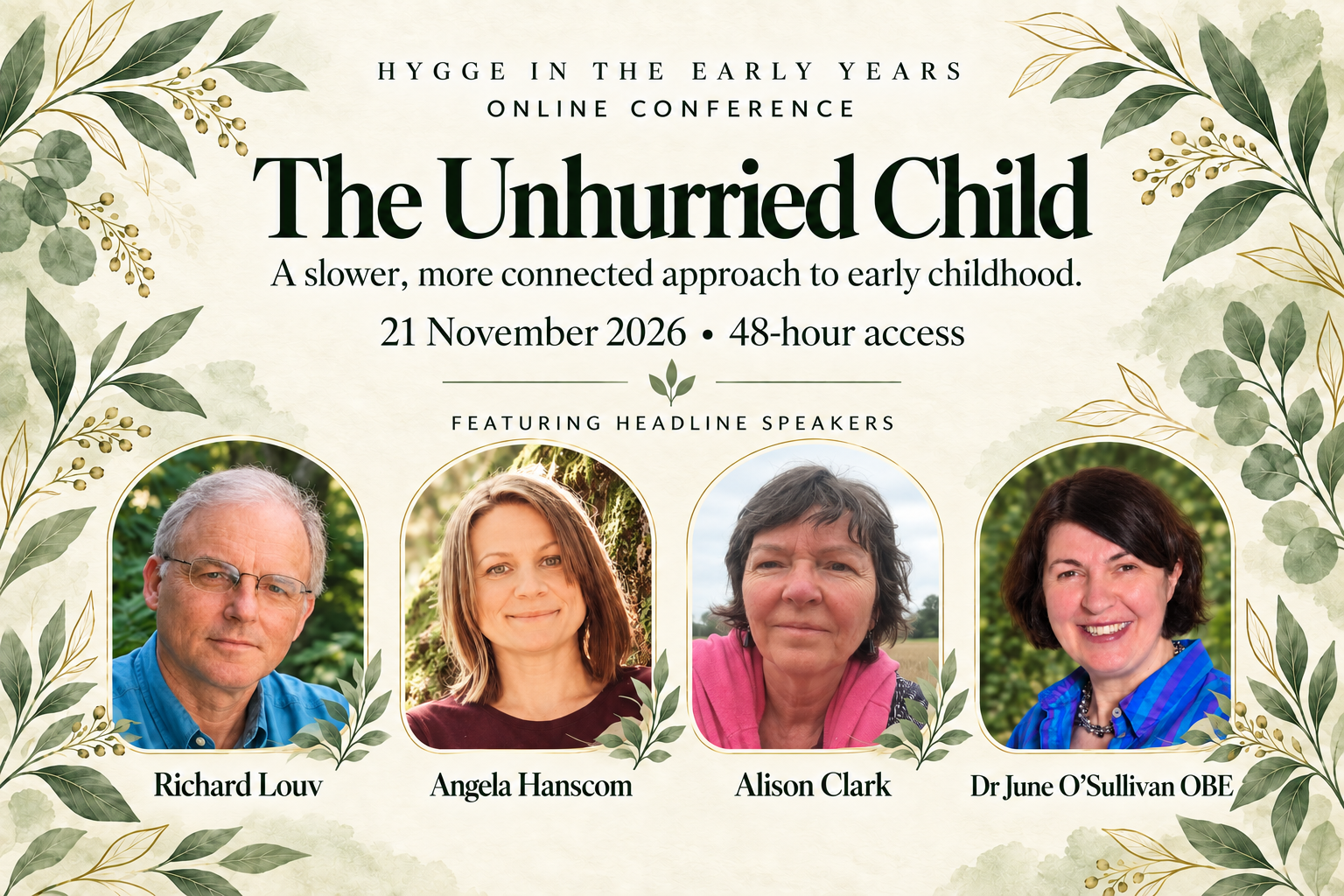
Online Conference
Online Conference
Curious about slow pedagogy?
”The Unhurried Child"
21st November 2026 (48 hour access)
A slower, more connected whole child approach to early childhood.
One inspiring online conference for educators ready to protect play, nurture wellbeing and give childhood back it's time.
