
Slow Pedagogy in Action
The Hole Punch That Reminded Me What Learning Really Looks Like
This week, a child became completely fascinated by a hole punch.
Not a new resource.
Not an expensive invitation to play.
Not a carefully planned activity.
Just a simple hole punch sitting on a table.
And for the next 30 minutes, they were utterly absorbed.
Punch.
Click.
A tiny circle falls.
Punch.
Click.
Another circle appears.
Again.
And again.
And again.
Watching them, I was reminded of something I think we've forgotten in early years education.
The deepest learning often doesn't happen in the activities we've planned.
It happens in the moments children choose for themselves.
Why We Struggle to Trust These Moments
I'll be honest.
Twenty years ago, I probably wouldn't have trusted this kind of play.
I'd have worried that I needed to move the child on.
Extend the learning.
Introduce a challenge.
Find a "next step."
After all, that's what many of us were taught to do.
Yet after more than 20 years working in Early Years, leading a school from inadequate to outstanding, supporting hundreds of settings and studying Scandinavian approaches to childhood, I've realised something important:
Children don't need us to constantly create learning.
Learning is already happening.
What they need is adults who are able to see it.
What Slow Pedagogy Really Means
Slow pedagogy isn't about doing less.
It's about noticing more.
It's about having the confidence to pause long enough to see what's unfolding in front of us.
To recognise that repetition isn't wasted time.
It's how children learn.
It's how they master skills.
It's how they regulate.
It's how they make sense of the world.
When a child punches hole after hole after hole, they're not "just fiddling."
They're building pathways in their brain.
They're developing concentration.
They're refining movement.
They're experiencing mastery.
And perhaps most importantly...
They're completely engaged.
🌿 Feeling Like Children Are Less Engaged Than They Used To Be?
This is one of the biggest conversations I'm having with educators right now.
They're planning more.
Preparing more.
Creating more.
Yet children seem increasingly distracted, overwhelmed and unable to sustain play.
In my FREE training, I'll show you the Scandinavian-inspired shifts that help children become calmer, more engaged and more deeply involved in their learning.
👉 Watch the FREE training here
A Hole Punch Is Never Just A Hole Punch
What fascinates me about child-led play is how much learning can be hidden within something seemingly simple.
A hole punch supports:
✨ Hand strength for writing
✨ Bilateral coordination
✨ Sustained attention
✨ Pattern recognition
✨ Cause and effect
✨ Sensory regulation
✨ Confidence through mastery
The child feels the pressure.
Hears the click.
Sees the result.
Every hole becomes a tiny act of agency.
A tiny reminder:
"I can do this."
And that's powerful.
Why Children Need Fewer Activities and More Time
One of the biggest myths in Early Years is that engagement comes from exciting activities.
It doesn't.
Engagement comes from ownership.
From curiosity.
From feeling safe enough to follow an idea for as long as you need.
Yet many children today are constantly moved on.
Interrupted.
Redirected.
Pulled away from the very experiences that are helping them learn.
When we slow down, something remarkable happens.
Children stay longer.
Think deeper.
Play harder.
Learn more.
The Adult's Role Isn't To Lead
It's to notice.
To wonder.
To be present.
Instead of:
"What colour is that?"
"What shape is that?"
"How many holes have you made?"
We might simply say:
🤍 "I can see you're really concentrating."
🤍 "You've spent a long time working on that."
🤍 "I wonder what you've noticed."
This kind of language communicates something important:
I trust you.
Your ideas matter.
Your learning matters.
What If We Stopped Looking For The Next Activity?
Sometimes I wonder how much pressure educators are carrying.
The pressure to create beautiful invitations.
The pressure to constantly provide new experiences.
The pressure to always be doing more.
But what if children don't need more?
What if they need less?
Less interruption.
Less rushing.
Less adult agendas.
More time.
More trust.
More opportunities to become deeply absorbed in what fascinates them.
The Real Magic of Slow Pedagogy
When we honour a child's fascination—whether it's a hole punch, a stick, a puddle or a ladybird—we send a powerful message:
✨ Your curiosity matters.
✨ Your pace matters.
✨ You don't need to hurry.
✨ You are already enough.
And perhaps that's what so many children are longing to hear.
Want to Create a Calmer, More Engaged Learning Environment?
If you've ever felt exhausted trying to plan more activities, more interventions and more experiences for children who still seem disengaged, I'd love to invite you to my free training.
🌿 FREE TRAINING: 3 Steps to Creating a Calmer, More Engaged Early Years Environment
Inside this free session, I'll show you:
✨ Why many children are becoming overwhelmed and disengaged
✨ The Scandinavian-inspired principles that transformed my teaching
✨ How to create deeper engagement without constantly planning more activities
✨ Why slowing down often leads to better outcomes for children
✨ Simple shifts you can implement immediately
Thousands of educators have already joined me and discovered that the answer isn't more.
It's often less.
Less rushing.
Less pressure.
More trust in childhood.
👉 CLICK HERE TO WATCH THE FREE TRAINING
Because when we slow down enough to truly see children...
They show us that learning has been there all along. 🤍
Have you tried my FREE Introduction to Hygge Training yet?
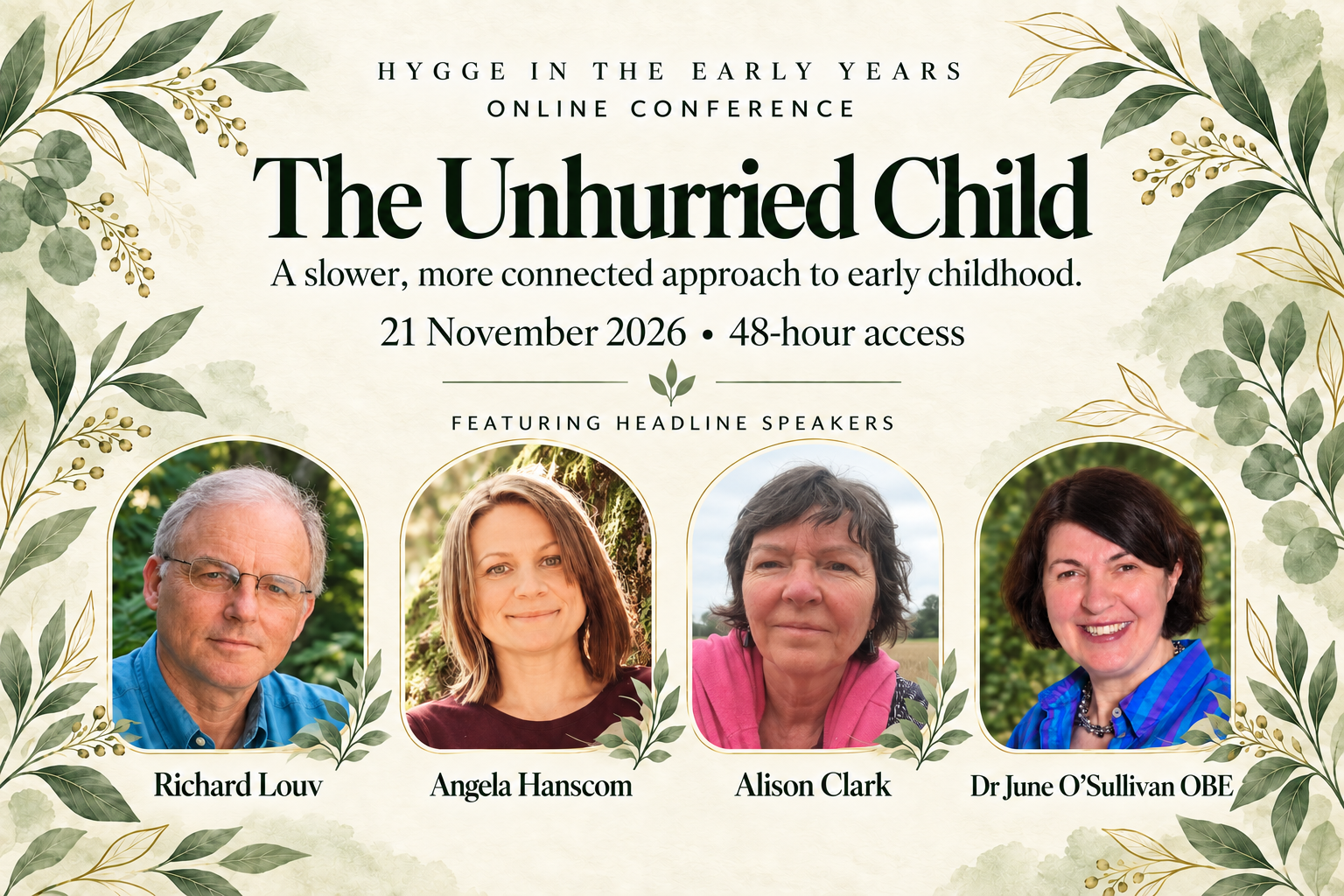
Online Conference
Online Conference
Curious about slow pedagogy?
”The Unhurried Child"
21st November 2026 (48 hour access)
A slower, more connected whole child approach to early childhood.
One inspiring online conference for educators ready to protect play, nurture wellbeing and give childhood back it's time.
