
Blog
A calmer way to teach, lead and nurture childhood.
Practical ideas, reflective insights and nature-led inspiration for educators who want to do less — and do it more meaningfully.
Start here if...
50 Outdoor Play Activities this Autumn

Autumn is one of the most beautiful times of year.
Here we share 50 play activities for you to get inspiration from. Some wonderful ideas for your left over pumpkins too - not just for Halloween!
You can also find weekly nature planning ideas and invitations to play in my Rewilding Nature Study Programme
A Gentle Reminder Before You Begin 🌿
It can be tempting to look at a long list of activities and feel like you should do them all. But the Hygge approach is about slowing down, not speeding up.
Children don’t need a packed timetable. What they need is:
-
Experiences linked to their current skills (what they are practising right now).
-
Play that reflects their interests (what lights them up and holds their attention).
-
Learning that grows from what we already know about them as individuals.
✨ Instead of rushing through all 50 ideas, choose just a few as seasonal hooks. Perhaps puddle jumping, conkers, or pumpkins. Offer these gently over the season, observe where t...
Autumn Leaves and Conkers Please - Conker Activities

Autumn Leaves and Conkers Please - Conker Activities from Gemma's Childminding, a Hygge Accredited setting.
'We love to incorporate natural, eco-friendly and recycled products into our play. Our activities are very much child-led these days rather than adult-initiated. I find that being around nature whether this is outdoors or bringing nature indoors really supports the children's learning and wellbeing.
I've noticed some real changes in the children since adapting to a more 'Hygge' based environment and embracing a slow pedagogy.
Some snapshots of how we have enjoyed incorporating conkers into our everyday play this season.'
Woodland Theme Autumn Display

We set up a small display of interest for the children to explore. Lots of natural resources including conkers, pinecones and leaves. We incorporated various lights and some magnifying boxes for them to identify the different textures and colours up close.
They especially loved feeding the conkers to the woodland animals.
Pl...
Slow Pedagogy in Action
The Hole Punch That Reminded Me What Learning Really Looks Like
This week, a child became completely fascinated by a hole punch.
Not a new resource.
Not an expensive invitation to play.
Not a carefully planned activity.
Just a simple hole punch sitting on a table.
And for the next 30 minutes, they were utterly absorbed.
Punch.
Click.
A tiny circle falls.
Punch.
Click.
Another circle appears.
Again.
And again.
And again.
Watching them, I was reminded of something I think we've forgotten in early years education.
The deepest learning often doesn't happen in the activities we've planned.
It happens in the moments children choose for themselves.
Why We Struggle to Trust These Moments
I'll be honest.
Twenty years ago, I probably wouldn't have trusted this kind of play.
I'd have worried that I needed to move the child on.
Extend the learning.
Introduce a challenge.
Find a "next step."
After all, that's what many of us were taught to do.
Yet after more than 20 years...
Exploring Elderflowers

The beautiful white, frothy elderflowers tend to bloom in late May, turning to

Here are a few activities to explore:
- Make delicious elderflower cordial or gin!
- Add them to cakes or biscuits
- Try them deep-fried to make tasty elderflower fritters
- Make elderflower jam
- Add them to homemade Playdough
- Add them to your mud kitchen and potions
- Paint Elderflowers using a cotton bud to create a spray of white flowers - or splatter the paint to see what effect you get.
Find out more about Hygge in the Early Years here.
Hygge in a Small Setting Case Study

Bringing Hygge into Happy Hearts Home: Creating a cosy and nurturing environment for young children.
When I first discovered the concept of hygge, I felt an instant connection. The idea of creating a calm, comforting space full of warmth and belonging aligned so closely with how I wanted children to feel in my care. As a childminder, I’ve always aimed to provide a home from home environment, but a hygge approach helped me to take this to a deeper level. It encouraged me to slow down, simplify and truly tune in to what children need to feel safe, nurtured and grounded.
In early childhood, emotional security lays the foundation for all learning and development. When children feel calm, connected and safe they are more able to explore, play and build positive relationships. I’ve come to realise that setting doesn’t need to be filled with noise, colour, or constant activity to be stimulating. Sometimes, the most powerful learning happens in stillness, in moments of shared warmth,...
10 Ideas for Ladybird Nature Play

Ladybirds are a beloved and valuable part of our natural world. It is lovely to find them in the garden or out and about in parks.

Some interesting facts about Ladybugs:
-
From the beetle family.
-
Common colors include red, yellow, and orange with black spots, but some species can be black with red or yellow spots.
-
There are about 5,000 species of ladybirds worldwide.
-
The seven-spot ladybird is one of the most familiar species in Europe.
-
The bright colors and spots of ladybirds serve as a warning to predators that they are toxic or distasteful.
-
When threatened, ladybirds can secrete a yellowish fluid from their leg joints, which has a foul taste and can deter predators.
-
Ladybirds are essential for natural pest control in gardens and agricultural fields, helping to reduce the need for chemical pesticides.
-
Ladybirds are often considered symbols of good luck and are associated with various folk beliefs and superstitions around the world.
8 Spring Blossom Play Ideas!
The blossom is in full bloom here and so I wanted to share some of the best ways you can bring it into the children's play.
'The significance of the cherry blossom tree in Japanese culture goes back hundreds of years. In their country, the cherry blossom represents the fragility and the beauty of life. It's a reminder that life is almost overwhelmingly beautiful but that it is also tragically short. '
Homaro Cantu

Don't be too busy to rush past the blossom trees but instead let them be a remind that life is short but beautiful and to look up and notice them.
1. Look up
Look up at the blossom and see all of it's beauty. If possible go and lay under a blossom tree with the children and practice a moment of stillness. What do the children see, smell, hear and feel? Why not place a perspex mirror under the tree or some water play (always supervise) to reflect the blossom and provide an interesting perspective in the play.
It's also a wonderful sensory experience to take your shoe...
Easter in Denmark

Easter is big in Denmark. It kicks off the summer season after a long, dull Nordic winter, and the Danes go all in for it. a
For Danes Easter means being together with loved ones, relaxing and having fun making new memories.

Here are a few ways Danes celebrate Easter.
Decorate the Home
Like everywhere else in the world, the egg is a major symbol of Easter, also in Denmark. It symbolizes new life and a new beginning. For decoration using egg shells, you can blow out your own egg by making a tiny hole at the bottom and top with a needle. You might decorate some hard boiled eggs and have them on the side to admire. You could collect some twigs from your garden and hang home made salt dough decorations on them too.

Spring flowers are also collected and displayed inside the home to embrace the element of nature.
Get Together
During Easter, Danes celebrate mostly the arrival of springtime and with Maundy Thursday, Good Friday, Easter Sunday and Easter Monday being national holida...
5 Simple Nature Inspired Outdoor Winter Activities for Babies

Here at Little Nature Tots we aim to provide inviting invitations for babies to play, explore & investigate.
Within our play we use lots of natural materials which we forage & enhance using other sensory objects.
Our stations are planned and set up to ignite sensory development within the 5 senses: See, Hear, Taste, Smell & Touch.

1. Bauble water play
Fill a tray with water & add different coloured baubles. Then add some fir or pine tree to add colour and texture. Allow your baby to look at, touch, roll & explore the objects in the water.

2. Winter rice play
Fill a tray with rice and add festive objects & colours. Here I also added some sticks to make patterns. Your baby will love to feel the rice with their fingers and toes.

3. Mud kitchen sensory play
Collect crunchy leaves & evergreens from around the garden. Add some small pots and pans. Your baby will love to explore the smells and textures.

4. Winter sensory tray
Using a foil blanket as the base, add a variet...
Hygge Friday

Guest Post by: Sam Goldsworthy
Since undertaking the Hygge accreditation we have really embraced the feeling of togetherness and cosiness. The one thing that struck a positive chord with us when reading about life in Denmark was the way they come together on a Friday afternoon to enjoy cake and celebrate the end of the week. We thought ‘wow’ we could do easily achieve this in our setting. So we originally planned to bake each Friday morning and come together in the afternoon to enjoy our bakes with a hot chocolate or a warm milk and reflect on the adventures that we have had together during the week.

Our Hygge Friday developed to include ‘voting'. So we would choose two recipes and ensure we had ingredients for both. We placed a picture with each bake with the wording underneath for the children to be able to read or visualise the choices depending on their age and stage of development. They would often ponder then, would choose a bake and write their name under the bake that the...
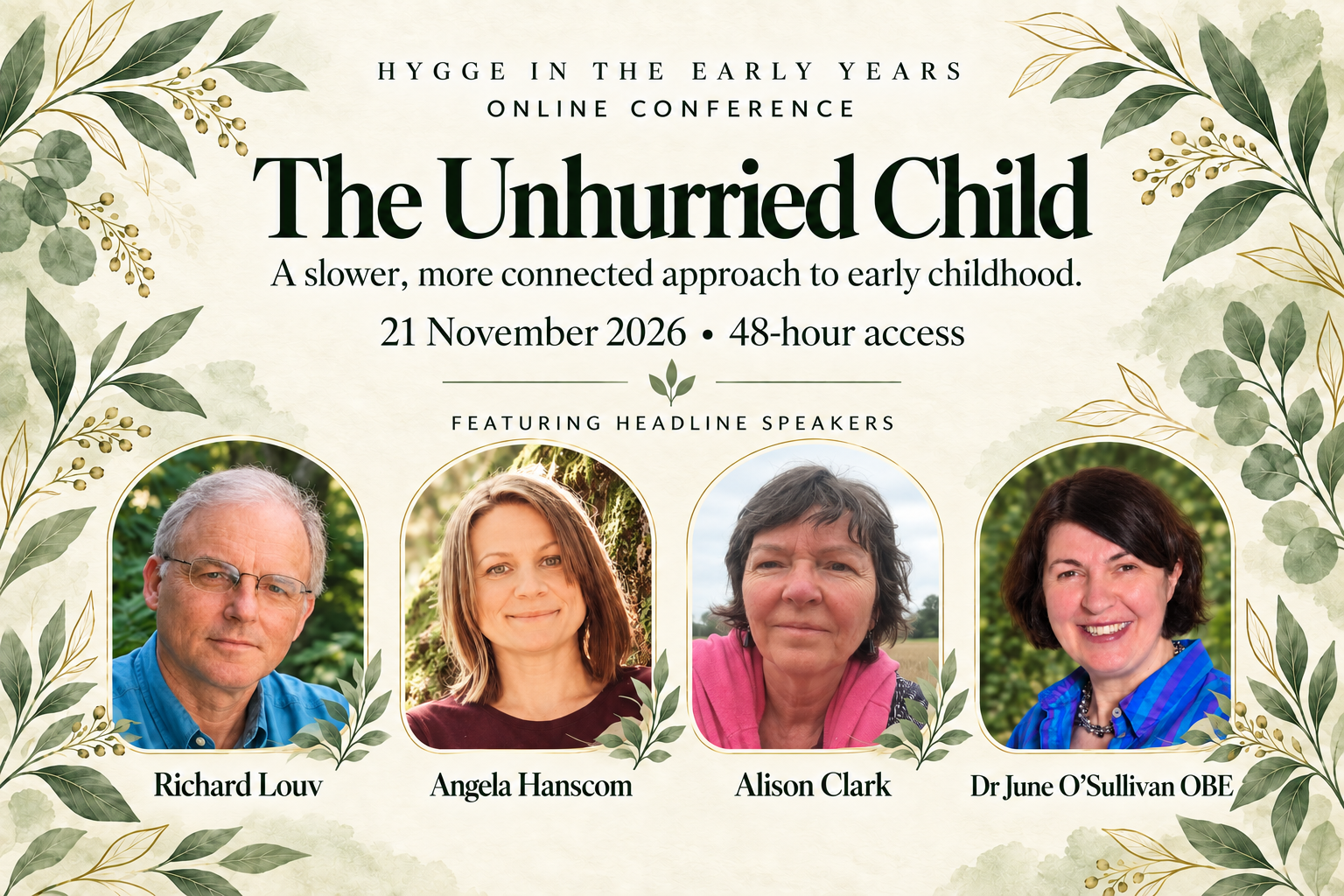
Online Conference
Online Conference
Curious about slow pedagogy?
”The Unhurried Child"
21st November 2026 (48 hour access)
A slower, more connected whole child approach to early childhood.
One inspiring online conference for educators ready to protect play, nurture wellbeing and give childhood back it's time.
